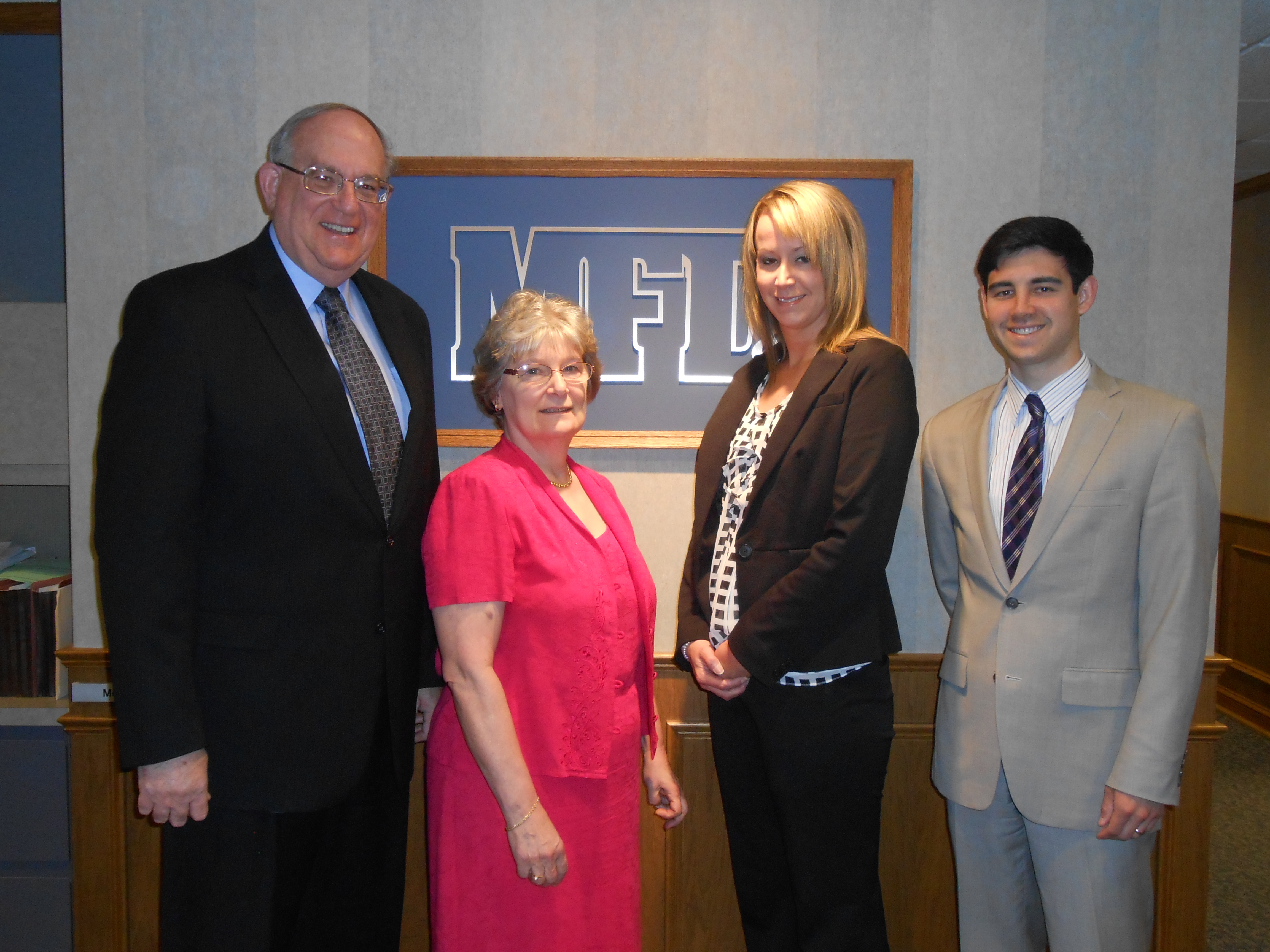
MFDD Participates in Equi-librium, Inc. Charity Golf Outing

Bill Dayton and Tim Duckworth, both shareholders of the Lehigh Valley law firm Mosebach, Funt, Dayton & Duckworth, P.C., with offices in both Bethlehem and Allentown, participated in the Annual Equi-librium Golf Classic at White Tail Golf Club on June 4th, 2014, with guests Matthew B. Searles and Jack McGorry.  MFDD takes pride in once again participating in and supporting this event.

Tim Duckworth, Jr. Serves on Board of Directors of Bethlehem Catholic High School

Tim Duckworth, Jr. was recently named to the Board of Directors of Bethlehem Catholic High School.

The Board was instituted to help navigate the school’s success, as implemented by an initiative of the Diocese of Allentown in partnership with the Healey Education Foundation through its signature initiative, the Catholic School Development Program, a non profit organization involved with sustaining and growing Catholic schools.

With a focus on strengthening Bethlehem Catholic’s position in the community, creating sustained growth, overcoming challenges, and developing tomorrow’s leaders, the Board began meeting in November and intends to offer “ongoing communication on its progress, including quarterly updates and annual ‘state of the school’ style meetings”.

A 2002 graduate of Bethlehem Catholic High School, Tim is proud to serve on the Board, with members being selected based on their talent, acumen, and strong moral character.

Pennsylvania Child Support

DUTY OF CHILD SUPPORT

Pennsylvania law typically requires the parents of a son or daughter to provide support to their child at least until he or she is 18 years old and graduates from high school.  The law presumes that parents living together are financially supporting their children.  But what happens when the parents are separated and living at different addresses, or are divorced?

Parents who live separate and apart or who are divorced still owe a duty to financially support their children as best they can, given their earnings history and capacity.  Often the parent who has physical custody of the children for most of the time will need to obtain help getting financial assistance for the children from the other parent.  How much financial support does the other parent owe?

Amount of Child Support

For most separated or divorced parents of children, Pennsylvania has established support guidelines for our courts to follow when determining how much child support a parent owes.  The amount of child support owed is based on the parents’ respective earnings or earning capacities and also the number of children who require financial support.  An earning capacity for a parent must be established if that parent is not earning as much as he or she is able to given his or her educational training, employment history, and earnings history.  Parents with combined monthly net incomes in excess of $30,000.00 per month present what are called “high income cases” and a particular analysis must be applied to these cases to calculate the parties’ respective child support obligations.

When both parties are salaried employees who receive W-2s for their tax returns – and who have no other sources of income – the calculation for determining the appropriate amount of child support is fairly uncomplicated.  But that situation changes once someone owns or derives income from a business.  In those cases, the business expenses can often be income for child support purposes.  For example, expenses for automobiles, cellular phones, or meals charged to the business, often become hidden income for Pennsylvania child support law purposes when those expenses are used for non-business purposes.

Additional Child Support Obligations

A parent owes more than just a monthly amount of income for child support.  There are also parental obligations for the costs of a minor child’s health insurance, extracurricular activities, private or parochial school tuition, unreimbursed medical, orthodontia, or psychological expenses.  A child support order will include directions for paying these types of expenses in addition to the monthly amount of basic child support.

How MFDD’s Experienced Family Law Team Can Help You With Child Support Issues

MFDD’s experienced family  law attorneys have the knowledge, skill, and technical support to calculate what income is available for child support.  We calculate either the actual earnings or earning capacities of both parents and determine respective net monthly incomes.  We then utilize a computer software program which mirrors the program used by Domestic Relations Sections throughout Pennsylvania to determine parental child support orders based upon the Pennsylvania Support Guidelines.  Of course, the more income available for child support, the higher the Support Guidelines for child support.

MFDD’s family law attorneys have many years of experience in helping clients who are seeking child support, or those being asked to provide child support, either as part of the divorce process or not.  We regularly represent parents at child support conferences and hearings which lead to the Court entering a child support order.  One major advantage of a child support order is that it permits wages to be garnished to pay for the child support obligation.  We also assist many MFDD clients in achieving a child support agreement so that neither parent has to appear in court.

We cannot address every child support issue in this article, but our experienced family law attorneys thoroughly address all child support issues of our clients.

Child Support / Spousal Support / Alimony / Divorce

Child support may be just one issue that needs to be addressed at the time of divorce.  The amount owed for child support can vary given the parents’ child custody arrangements.  The issues of spousal support, or APL before divorce and alimony after divorce, are other family law issues which we will address in a future article on this site.

Contact MFDD

Please do not hesitate to contact MFDD’s experienced family law attorneys for advice on child support and all other legal matters related to divorce or separation.  MFDD offers comprehensive initial consultations to address all family law questions at a reasonable cost.

Can You be Liable for the Bills and Support of an Indigent Parent in Pennsylvania?

Pennsylvania has had some form of law on its books imposing a duty upon a child to support indigent parents since 1771. Previously these laws were part of Pennsylvania’s Welfare Laws, but since July, 2005 they have been part of its Support Laws. These types of laws are known as “filial support laws” and in Pennsylvania the law can be found at 23 Pa. C.S.A. §4603 (hereinafter the “Pennsylvania Support Act”).

The filial support laws exist for the primary purpose of limiting the financial burden the government incurs as the “payor-of-last-resort” for support and necessary services of a person.  In other words, these laws exist in order to relieve the government from the burden of supporting poor people who have family members that are capable of paying for a poor person’s care. 

            The Pennsylvania Support Act states that the spouse, child and a parent of an indigent person are responsible for the cost to care for and maintain or financially assist the indigent person regardless of whether the indigent person is a public charge. The only two exceptions would be if the individual who has potential liability does not have the financial ability to support the indigent person, or in the case of a child who has potential liability to support a parent, if the parent abandoned the child for a period of ten years or more prior to the child reaching age 18.

An action under the Pennsylvania Support Act can be brought by the indigent individual or any public agency involved in the care of the indigent person, such as Department of Public Welfare. In addition, it has long been the law in Pennsylvania that a nursing home which provides an indigent parent with shelter and care has a sufficient interest to apply the Pennsylvania Support Act against the parent’s child.  

As the Court recognized in Savoy v. Savoy, 641 A.2d 596, 599 (Pa. Super. 1994), the Pennsylvania Support Act does not define the term “indigent”. The public assistance guidelines used by the Department of Public Welfare to determine eligibility for Medicaid are not used to determine indigent status because the Pennsylvania Support Act applies to individuals regardless of whether they are a public charge. The Savoy Court held that Pennsylvania Courts have applied the common-law definition of indigence and in doing so have held that:

The indigent person need not be helpless and in extreme want, so completely destitute of property, as to require assistance from the public.  Indigent persons are those who do not have sufficient means to pay for their own care and maintenance.  “Indigent” includes, but is not limited to, those who are completely destitute and helpless.  It also encompasses those persons who have some limited means, but whose means are not sufficient to adequately provide for their maintenance and support.

A child’s parent was deemed to be indigent because the child removed over $100,000.00 from the mother’s bank account causing the mother to be unable to pay for her care and support.  Presbyterian Medical Center v. Budd, 832 A.2d1066 (Pa. Super. 2003). Another example of the Court finding a parent indigent involved a situation where a mother received $1,000.00 per month as income and the Court determined that this was not sufficient for the mother to adequately provide for her own maintenance and support. Healthcare and Retirement Corporation of American v. Pittas, 46 A.3d 719, (Pa. Super. 2012).

The Pennsylvania Support Act does limit the amount of liability that can be assessed against an individual for support of an indigent person or services provided to them.  The amount of support liability during any 12 month period must be the lesser of (i) six times the excess of the liable individual’s average monthly income over the amount required for the reasonable support of the liable individual and other persons dependent upon the liable individual or (ii) the cost of the medical assistance for the aged person. 23 Pa.C.S.A. §4603(b). The Department of Public Welfare may adjust the liability set by Court Order, even to the point of eliminating the liability completely.  In the event there is a Court Order for an individual to pay filial support and the person fails to comply with that obligation, the liable person may face contempt charges, and if found to be in contempt, could be sentenced to up to six months in prison in addition to having to satisfy the Court Order. 23 Pa.C.S.A. §4603(d).

While not having sufficient financial ability to support the indigent person is a defense to a filial support action, mere assertion of inability to pay for the indigent parent without sufficient proof is not enough.  In Pittas, the nursing home was able to establish financial ability for a son to pay by submitting four years of the son’s tax returns and bank account statements. Pittas also held that the Pennsylvania Support Act does not require consideration of a pending Medicaid application, or that other members of the indigent person’s family may be able to support the indigent parent. Accordingly, a third party providing necessary services for an indigent parent may choose from one or more of the possible family defendants against whom to file its claim.  The family member named in the initial legal action may join any other family member allowed under the Pennsylvania Support Act, such as the indigent person’s spouse or other children of the indigent person.

There is no provision in the Pennsylvania Support Act which requires a Court to consider the good or bad behavior of a potentially liable individual. A child who has had no relationship with an indigent parent could be found to have the same liability as a child who has an ongoing relationship with the indigent parent during the same period of time. Whether a child provides care, services and comfort to the parent, or has improperly handled the parent’s assets, there is no difference in applying the statute. The statutory relationship of the relative to the indigent individual and the statutory relative’s ability to pay are the only requirements necessary under the Pennsylvania Support Act.  Presbyterian Medical Center v. Budd, supra.

The current case law in Pennsylvania now allows collection actions to be instituted against an adult child for the long-term care obligations of a parent retroactively, in addition to establishing a support obligation prospectively. Liability under the Pennsylvania Support Act has been interpreted to place an affirmative duty upon a child of an indigent person to reimburse from the child’s assets, the expenditures of a third party on behalf of an indigent parent. Albert Einstein Medical Center v. Forman, 243 A.2d 1066 (Pa. Super. 2003). In Pittas, supra, the Pennsylvania Superior Court upheld a Lehigh County judgment in the amount of $93,000.00 rendered in favor of a nursing home and against the son of a mother who spent six months in the facility and then relocated to Greece without paying the bill. The restaurant owner son, who was married with a child and a second on the way and claimed an annual income of $85,000.00, was found liable for the full amount of the judgment despite the fact that he did not have any contractual relationship with the nursing home; the mother had income of $1,000.00 per month; there was a pending Medicaid application for the mother; and two other siblings of the son lived in Greece.

The Pittas decision was appealed to the Pennsylvania Supreme Court, but it decided not to hear the appeal. 63 A.3d 1248 (Pa. 2013).  Thus, the Superior Court decision in Pittas is currently the law of Pennsylvania with regard to filial support obligations being applied retroactively.

            Several pieces of legislation regarding the Pennsylvania Support Act were proposed in both the Senate and House of Representatives during the 2013-2014 legislative year.  All of the proposed bills would have lessened the impact of the Pennsylvania Support Act, even to the point of removing potential relative liability altogether.  However, the fact that no action has been taken on any of these bills demonstrates that Pennsylvania will continue to maintain that the government is to be the payor-of-last-resort.

Items of interest on this matter, and in particular the Pittas case, are a news article by Susanna Kim for ABC News entitled Pennsylvania Man Appeals to Court to Avoid Paying Mom’s $93,000.00 Nursing Home Bill and a video presentation posted on YouTube, entitled Elder Law Expert Katherine Pearson Explains New Family Support Decision in PA and its Policy Issues.

As with so many issues in the elder law and estate planning areas, competent legal advice is necessary, and Mosebach, Funt, Dayton & Duckworth, P.C. is available to assist you.

MFDD Attends Law Day Luncheon

lawday2MFDD was proud to participate in the May 1, 2014 Law Day Luncheon held at the Bar Association of Lehigh County. Five members of the firm were in attendance (L-R Hal Funt, Debbie Galm, Jenal Hettler, and Tim Duckworth, Jr. – John Hacker not shown). The event focused on the fundamental need of the United States as a democracy to ensure that every citizen has the right to vote. The striving to establish every citizen’s right to vote has been, and continues to be, a central theme of American legal and civic history. The League of Women Voters of Lehigh County was honored for their untiring efforts in securing the right to vote for all American citizens.

Shareholders Attend CIS Awards Dinner

Shareholders Barry Mosebach, Bill Dayton, and Kristie Beitler attended the Communities in Schools Lehigh Valley Awards Dinner at DeSales University on Wednesday, April 23rd, 2014.  Kristie is a current CIS board member and Barry has previously served on the Board.  Mosebach, Funt, Dayton & Duckworth, P.C. continues to be a proud supporter of the CIS program, which helps at-risk students achieve high school diplomas.

Timothy J. Duckworth accredited – Veterans Affairs

Timothy J. Duckworth was recently accredited to practice before the Department of Veterans Affairs.  In addition to the broad range of estate planning and elder law services that Tim performs, he is now able to assist clients in the preparation, presentation, and prosecution of claims for Veterans Administration benefits from the initial application through appeals to the Board of Veterans Appeals.

Corporate Compliance Company, Corporate Records Service Scam

You should be aware of a recent scam being sent to businesses registered with the Pennsylvania Department of State (“Department of State”) and with the departments of other jurisdictions.

In this scam, companies identified as Pennsylvania Corporate Compliance Company and Corporate Records Service are sending solicitations under the headings Annual Meeting Disclosure Statement and 2014 – Annual Records Solicitation Form. The solicitations request that you complete an information form, remit a $125 filing fee, and respond by a specified date. Sample Solicitation.

Although the solicitations appear to be official, none of the information requested has to be filed with the Department of State and the solicitations should be disregarded.  The Department of State is alerting all businesses to this deceptive solicitation to prevent businesses from completing the form and sending payment to the address listed.

Please be aware that any official notices sent to businesses by the Department of State will contain the letterhead and/or contact information for the Pennsylvania Bureau of Corporations and Charitable Organizations.

Please do not hesitate to contact us with any questions or concerns regarding this scam or any other solicitations you may receive.

Recent Cases in Debtor-Creditor Law

CLAIMS AGAINST ENTIRETIES PROPERTY

A recent case of first impression in Pennsylvania was recently addressed by the Pennsylvania Superior Court in the case of Rajaratnam v. Rajaratnam, 2013 WL 6164324 (Pa.Super. Nov. 25, 2013).  Husband signed a guarantee in favor of a bank for a business debt in 2005.  Husband and wife both signed a guarantee in favor of the same bank for the same business debt in 2007.  The bank confessed judgment against husband under his 2005 guaranty in 2009.  The bank sued wife under the 2007 guaranty and obtained a judgment in 2012.  The bank then tried to use these judgments to execute on certain real property owned by husband and wife as tenants by the entireties.

The Superior Court held that the bank could not execute on the entireties property because the bank did not hold a joint claim against the husband and wife, even though the separate judgments were claims for the same underlying indebtedness.

Thus, when executing on entireties property, joint judgments against husband and wife are required.  Separate judgments, even if the claims underlying them are for the same indebtedness, cannot be consolidated in Pennsylvania or used to execute on entireties property.

IMPLIED COVENANT OF GOOD FAITH AND FAIR DEALING

Is there an implied covenant of good faith and fair dealing in Pennsylvania?  The issue has been the subject of conflicting case law in Pennsylvania, and even the Pennsylvania Supreme Court has acknowledged a considerable amount of confusion as to whether such an implied covenant arises in every contract under Pennsylvania law.

The United States District Court for the Western District of Pennsylvania recently joined those courts answering the question affirmatively, holding that “an implied covenant of good faith and fair dealing is incorporated into every Pennsylvania contract”.  Hersh v. CitiMortgage, 2013 WL 6858443 (W.D.Pa. Dec.30, 2013).  The court noted that a claim for breach of this implied covenant could only be raised as a standalone breach of contract claim, and could not be raised together with a claim for breach of an express contract provision (because the implied covenant is “subsumed” within the breach of contract claim).

Harold J. Funt joins Bethlehem Rotary

Harold J. Funt, Esquire has recently become a member of the Bethlehem Rotary Club.  He looks forward to participating in community service projects and events.